


When the one-trick broker runs out of road

Publication Date: Monday, 27 July 2026
This article originally appeared in AustralianBroker
Market share for resi is at new highs – so why are the smartest brokers looking somewhere else?
WHEN A market hits a record high, the smartest players temper celebration with caution. They ask what they’re missing. With mortgage brokers now writing 81% of all new home loans in Australia, the wise understand that when the growth ceiling gets closer, you need to look sideways.
Clients are getting more complex. Their financial lives don’t fit cleanly into a single payslip or a standard owner-occupier application. And the brokers who are pulling ahead aren’t necessarily writing more loans. They are writing different ones.
Diversification has become one of the more overworked words in Australian financial services, but the conversation happening among specialist lenders right now is more specific and practical than the usual exhortations to brokers to broaden out. It’s about capability, risk discipline and the kind of deliberate positioning that separates a transactional operator from a trusted adviser.
Beyond the payslip
The starting point is the borrower, and the borrower is changing. “The client profile is becoming more diverse, both financially and demographically,” says Aaron Taylor, head of non-standard lending at Bluestone Home Loans. “For brokers, that means more opportunity to support a wider range of clients and build stronger, longer-term relationships. More borrowers have income that doesn’t fit neatly into a payslip, and more expect solutions that reflect their real circumstances.”
That shift has been building for years, but its implications for brokers are still working through the industry. A growing proportion of working Australians are self-employed, operating through trusts or company structures, have multiple income streams or operate somewhere between contractors and business owners.
According to the latest ABS Characteristics of Employment survey, there were 1.1 million independent contractors in Australia as of August 2025, representing 7.6% of all employed people – an increase of 33,000 from August 2024.
Separately, the latest ABS Labour Account Australia recorded 978,000 multiple-job holders, representing a multiple-job-holding rate of 6.5%. The multiple-job-holding rate held between 5.0% and 6.0% for the 25 years to 2019 but has remained at record highs of between 6.4% and 6.7% since June 2022. This is a cohort whose blended or variable income streams often sit outside standard lending criteria.

Standard credit models were not built for such groups, which means brokers who rely solely on standard products are, by definition, turning some of those clients away.
Chris Meaker, head of sales and distribution at Brighten Home Loans, sees this as a structural opportunity rather than an edge-case problem. “Many borrowers don’t fit into a neat lending box, so we work closely with brokers to understand the full story behind each application,” he says. Through scenario support, tailored credit assessment and adaptable documentation requirements, Brighten works to help brokers find solutions for clients who might otherwise be overlooked.
Taylor echoes that framing. “We’re seeing a shift in mindset from leading brokers,” he says. “Non-bank solutions are increasingly part of the plan from the start, of the discussion with clients. Brokers who take that proactive approach tend to move faster and deliver a smoother experience for their clients.”
The commercial gap
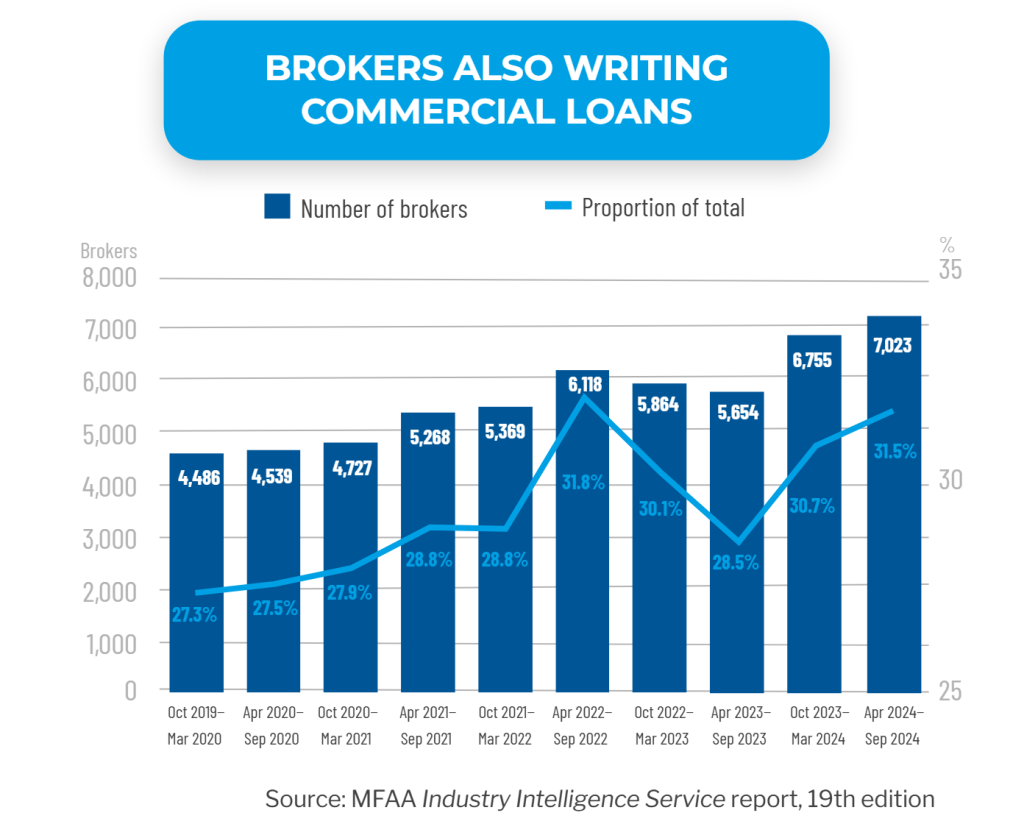
If alt doc and non-standard residential represent one growth frontier, commercial lending represents another – and a significantly underdeveloped one. Broker penetration in commercial sits well below residential, and the reasons are less structural than psychological.
“Commercial broker penetration still lags residential largely because of perception rather than actual accessibility,” says Meaker. “Many brokers view commercial lending as more complex, time-intensive and outside their core skill set, particularly when it comes to structuring deals, interpreting financials or navigating different credit frameworks.”
Taylor is more direct about what is holding brokers back. “Confidence and complexity can be barriers for brokers wanting to diversify,” he says. “Commercial property deals can be more nuanced and, without the right support, can feel complex or challenging for brokers who haven’t spent time in that space.”
The recent removal of negative gearing on established residential properties and the restructuring of the capital gains tax discount also reduce residential investment’s appeal for many buyers. Commercial property, by contrast, retains full negative gearing benefits – a structural advantage that could draw investors who are reassessing their portfolios in light of the new rules.
Some non-banks see the gap beginning to close, partly because residential brokers already have the potential clients. Most established brokers are sitting on a book of business owners, investors and self-employed clients with commercial or business lending needs they are not being asked about. The conversations are already there. The product knowledge is the missing piece.
“Brokers who take a gradual approach – starting with simpler commercial scenarios and building from there – are realising that it’s a natural extension of the relationships they already have,” says Meaker.
What goes wrong
Diversification done poorly can be damaging. Deals fall over. Compliance files come up short. Clients end up in products that don’t suit their circumstances. Understanding how that happens is as useful as understanding how to avoid it.
“When diversification doesn’t go to plan, it typically comes back to a gap between experience and preparation,” says Meaker. “This might show up as a deal that falls over because it wasn’t structured correctly upfront, a client being placed in a product that doesn’t fully meet their needs or documentation that doesn’t stand up to compliance requirements.”
Such failures are not deliberate. They stem from insufficient familiarity with the nuances of a new segment or product combined with moving too fast. “In most cases, it’s not a failure of intent – it’s a lack of familiarity with the nuances of a new segment or product,” says Meaker.
Taylor reframes the question slightly. “What often gets mistaken for ‘diversification risk’ is really just a lack of early alignment,” he says. “Stepping into something new without a sounding board can let uncertainty creep in.” Brokers who bring their scenarios to their BDM early can workshop structure, create clarity upfront and move forward with confidence.”
“Diversifying can be a powerful growth lever for brokers,” Taylor adds. “With the right support around them, stepping into new areas becomes simpler, more confident and far more scalable.”
Thinking in segments, not just products
One of the more interesting threads in both conversations is the argument for segment-led diversification rather than product-led diversification. The typical industry conversation focuses on adding commercial or alt doc to a broker’s suite. The alternative is to pick a borrower type and go deep.
“There’s absolutely a strong case for diversifying client segments, and in many ways, it can be more impactful than product-led diversification,” says Meaker. A broker who focuses on self-employed clients, for example, may work closely with accountants, develop fluency in interpreting non-standard income and build a referral network that generates its own momentum. The product knowledge follows from the segment, rather than the other way around.
“Brokers who take a gradual approach [to commercial lending] – starting with simpler … scenarios and building from there – are realising that it’s a natural extension of the relationships they already have” – Chris Meaker, Brighten Home Loans
Taylor agrees. “Brokers who focus on a clear segment often build deeper expertise and stronger referral networks,” he says. “In practice, it’s about understanding the common challenges within that segment, aligning with lenders who can support those needs and creating a consistent, confident experience. Over time, that positioning becomes a real driver of growth.”
The practical implication is that diversification doesn’t require a broker to become a generalist across every product category. It can mean becoming a genuine specialist for a particular kind of borrower.
The referral question
Expanding the scope of what a broker does inevitably raises the question of where that scope ends. Clients with complex financial lives often need more than a lending solution. They might need tax advice, financial planning and legal input. Brokers who are deepening client relationships will eventually hit that boundary.
“Brokers play a central role, but they don’t need to do everything,” says Taylor. “The best outcomes can be the result of a trusted hub of strong referral relationships with accountants, financial advisers and specialists. Knowing when to bring others in is a strength, not a limitation.”
Meaker makes the same point from a different angle. “As brokers take on a more central role in a client’s financial life, it’s important they think of themselves as the hub of a broader professional network, rather than a substitute for other specialist,” he says. The value lies in understanding the client’s overall position and recognising when specialist input is required. “Knowing when to refer is just as important as knowing how to structure a loan.”
Building incrementally
The picture that emerges from both lenders is consistent. Diversification is not a switch to flip. It is a capability to build, deal by deal, segment by segment, with lender support filling the gaps while broker confidence accumulates.
“Brokers who succeed tend to start small, lean on lender support and gradually build confidence through experience,” says Meaker. “Putting the right processes and checks in place early is also critical, particularly from a compliance perspective.”
For Taylor, the common thread across all of it comes back to one thing – partnering with capable lenders. “Brokers don’t need to have every answer,” he says, “but they do need the right support around them.”