


The construction finance dating game

Publication Date: Monday, 31 August 2026
This article originally appeared in Mortgage Professional Australia
Construction lending is recovering unevenly as approvals rise, costs stabilise and lenders sharpen their focus on feasibility, labour capacity and which projects deserve their support
CONSTRUCTION FINANCE runs a lot like a dating show. Contestants show up with polished profiles and long resumes. Lenders run background checks, sit through the pitch and try to work out who’s serious and who’s just here for the exposure. Nobody moves to the next round on charm alone.
Approvals are climbing, but completions are not keeping pace. That mismatch, more than any single rate move or policy announcement, is shaping how brokers approach construction finance right now.
“In today’s market, certainty and speed can be just as valuable as price” – Chris Meaker, Brighten
Cost pressures have eased from their post-pandemic peak, but insolvency rates across the building sector remain elevated, and lenders are responding by tightening how they assess delivery risk rather than pulling back from the market altogether. The tension running through construction finance right now isn’t a lack of demand. It’s whether projects can actually get built.
A market moving in different directions
Ask leading construction finance lenders to describe the same market, and you get subtly different answers, which says something about how uneven the recovery is.
For Blake Buchanan, general manager at Specialist Finance Group (SFG), the headline number is completions, not approvals.
“Dwelling approvals have improved compared with 12 months ago, but the recovery remains uneven,” he says. Detached housing has held up better than apartments and medium-density projects, and the output side of the ledger is the real worry.
“Completions are the main concern, with the lowest number of homes completed in 2025 in 12 years,” Buchanan says. Cory Bannister, senior vice president and chief lending officer at La Trobe Financial, has watched the same conditions impact the industry over the past year. “The past 12 months have tested the sector, with input cost volatility and supply chain reliability creating challenges for borrowers, builders and lenders,” he says.
He is now seeing signs that those pressures are easing.
“Encouragingly, we are now seeing those conditions begin to stabilise, which should support a more active and confident market over the period ahead,” Bannister says.
Chris Meaker, head of sales and distribution at Brighten, sees the same period through a different lens, one built from his own loan book. “The market is noticeably more positive than it was 12 months ago,” he says. Brighten’s own figures back that up. “Application volumes increased by 145% between 2024 and 2025, while application values grew by 176%, highlighting both stronger demand and larger loan sizes,” says Meaker.
That growth hasn’t slowed.
“Momentum has continued into 2026, with application volumes for the first three-quarters already 112% higher than the whole of 2025, with application values increasing by a similar margin,” he says.
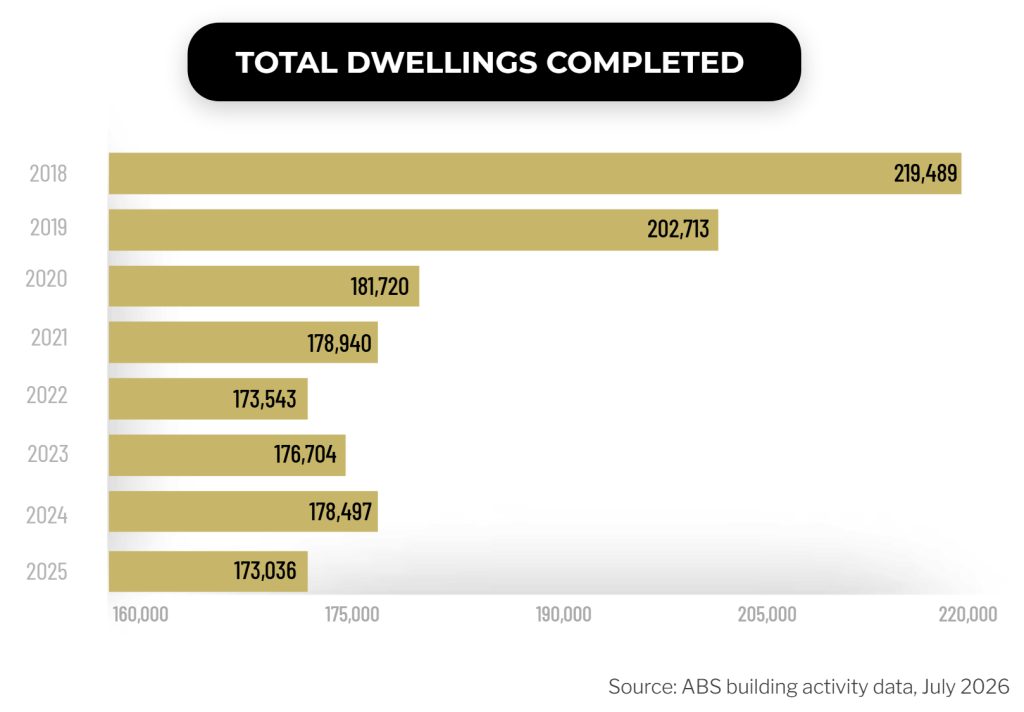
Backing this up, monthly housing approvals have been up year over year since February on a seasonally adjusted basis despite several monthly drops over the same period.
Colin Robinson, head of construction risk at Millbrook Group, sits somewhere between the two. Softer infrastructure activity and subdued private development have left more builders chasing fewer projects, pushing prices down in some sectors.
“The construction finance market remains challenging, with a number of competing influences shaping the environment,” he says. “Global events … have placed upward pressure on certain construction costs, so while overall market conditions have softened, cost volatility remains an important consideration for developers and lenders alike.” Arnold notes, “The construction finance market remains active, but participants are operating with greater discipline than they were 12 months ago. The focus has shifted from growth at all costs to execution, risk management and project delivery.”
Lee Prior, director of distribution at ORDE Financial, meanwhile, points to demand fundamentals that outlast any single quarter’s numbers. Population growth and a generational shift are doing the heavy lifting. “There’s no denying housing construction remains a challenging environment for Australia,” he says.
Even so, ORDE’s own research points to sustained appetite. “Our Outlook Australia research with Bernard Salt found many of Australia’s seven million millennials are moving into their forever home years over the next decade,” says Prior.
The people building that supply are a growing cohort in their own right. “Our research also shows Australia’s tradie workforce has grown to almost two million people. Around 374,000 tradies are owner-managers, meaning almost one in five tradies runs a business,” he says.
Banks compete, non-banks specialise
If there’s one thing everybody agrees on, it’s that the split between bank and non-bank construction lending is not static, and brokers who treat it as a binary choice are missing the point.
Robinson has watched the major lenders sharpen their offer. “We have seen banks become noticeably more competitive over the past 12 months, with a greater willingness to provide flexible construction funding solutions,” he says.
Arnold sees both sides of the market leaning on their strengths rather than competing purely on rate. “Banks and non-bank lenders both play an important role in the market, but borrowers are increasingly seeking funding partners that can offer certainty, responsiveness and specialist expertise,” he says.
That hasn’t pushed non-banks out of the conversation. Robinson notes that developers are still willing to pay for certainty. “Many experienced developers are prepared to pay a modest premium for a funding solution that is delivered quickly, consistently and with greater certainty throughout the transaction process,” he says.
Buchanan frames the split around where clients sit on the risk curve. “Banks will remain the primary source of construction finance, particularly for straightforward owner-occupied projects,” he says.
For everyone else, having options matters more than which lender wins. “The best outcome for clients is having a broader range of funding options, allowing solutions to be tailored to their circumstances rather than forcing them into a single lender’s credit policy,” Buchanan says.
Bannister expects non-banks to keep taking on a bigger share of that role as borrowers look for flexibility banks can’t always offer. “We expect non-bank lenders to play an increasingly pivotal role in construction finance as borrowers seek greater flexibility and certainty,” he says.
Price is no longer the deciding factor it once was.
“Increasingly, borrowers aren’t choosing between banks and non-banks based purely on price. They’re choosing the lender best equipped to help them deliver the project successfully,” says Bannister.
Prior sees the same pattern from the non-bank side, driven by borrowers who don’t fit a standard template. “The growing number of self-employed, SME and non-standard borrowing structures is one of the reasons we believe non-bank lenders will continue to play a larger role,” he says.
That flexibility is the point of difference. “Rather than relying solely on standardised criteria, we’re able to take a practical view of the borrower, the project and the broader opportunity,” says Prior.
Meaker expects that shift to continue as major bank appetite becomes more selective. “We expect non-bank lenders to continue increasing their share of the market,” he says. “Non-banks are well positioned to support borrowers whose circumstances may not fit traditional bank policy, particularly self-employed and alt doc customers who can struggle to access construction finance through major banks.”
Feasibility under the microscope
Another common thread is that the numbers on any feasibility study matter less than the people standing behind them.
Robinson says discipline was never optional at Millbrook, but the margin for error has narrowed. “At Millbrook, rigorous feasibility assessment has always been central to our credit process. We place significant emphasis on construction costs, project viability and a developer’s capacity to manage unforeseen cost increases or delivery delays,” he says.
Bannister notes that La Trobe Financial has taken a different route, holding its process steady rather than tightening it further. “Our approach to assessing construction finance opportunities remains unchanged. We’ve honed our credit appetite over several decades, which is why brokers and developers tell us consistency and reliability are our greatest strengths,” he says.
Buchanan agrees the basics haven’t changed so much as intensified. “We place greater emphasis on contingency allowances, builder capability, presales quality and the developer’s liquidity position,” he says.
Arnold observes that the bigger change for Pallas Capital has come after settlement, not before it. “The core principles of our credit assessment process remain unchanged, but our focus on construction risk monitoring has increased significantly over recent years,” he says.
Prior makes a similar point about looking past the finished product. “The fundamentals haven’t changed, but we’ve become even more focused on understanding the full project, not just the completed value of the property,” he says.
Policy pulling in different directions
Government housing policy has become a bigger factor in construction finance than it was even a couple of years ago, though not everyone thinks the effect has been positive.
Meaker points to the 2026 Federal Budget as a genuine turning point for investor demand.
“Importantly, recent tax changes announced in the 2026 Federal Budget are likely to direct more investor demand toward new housing stock,” he says. The scale of the supply gap gives that shift some urgency. “Australia also remains well behind the pace required to deliver the National Housing Accord target of 1.2 million homes by 2029, which reinforces the ongoing need for funding solutions that can help bring new housing supply to market,” Meaker says.
Bannister takes a more cautious line on how much weight policy should carry in a credit decision, noting, “While policy settings can influence activity and accelerate opportunities, they do not replace sound credit fundamentals.”
Robinson’s view is more mixed. He welcomes the intent but not always the execution. “We welcome government initiatives that support increased housing supply and improve planning efficiency,” he says, but approval timelines remain the sticking point in several jurisdictions. “While approval processes have improved in some jurisdictions,” he notes, “there is still considerable red tape that slows private sector development.”
Arnold treats policy as one input among several rather than the deciding factor, testing settings against a project’s own numbers. “Our role is not to rely solely on policy settings but to assess how those settings influence the underlying fundamentals of a particular project,” he says.
Buchanan is blunter. “It appears that the more the government intervenes, the worse the supply issue becomes,” he says, before adding a dry aside: “Thanks, government!”
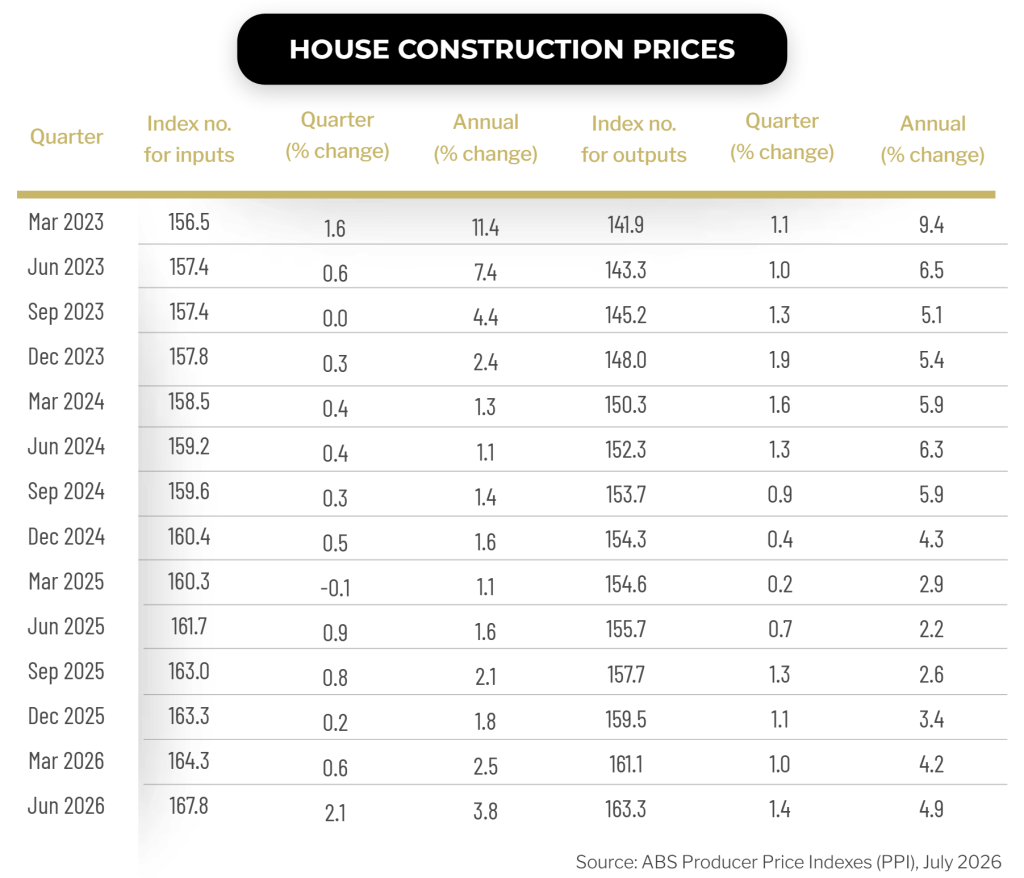
ABS producer price figures give some shape to that frustration on the cost side. Input-cost growth for house construction has slowed from an annual rate of 11.4% in March 2023 to 3.8% in the June 2026 quarter, while output prices have eased from 9.4% to 4.9% annual growth over the same period, according to the ABS Producer Price Indexes, suggesting that while prices may be creeping up again, the sharpest cost pressures of recent years have passed even if supply hasn’t caught up.
Modular construction finds its footing
Prefabricated and modular building is no longer a novelty on lenders’ desks, though it still requires a different kind of assessment.
Robinson says the cash flow profile of modular projects is the main adjustment lenders need to make. “Prefabricated and modular construction presents some unique funding considerations, particularly around upfront deposit payments and financing construction that occurs off-site before installation,” he says.
Bannister points to prefabrication and modular construction as trends worth watching closely, particularly for what they can do to delivery speed and cost predictability. “Prefabrication and modular construction are important trends to watch, particularly where they can support faster delivery, more predictable costs and improved construction quality,” he says.
Buchanan sees these trends as a gradual shift rather than a shock to the system. “It [is more] an evolution than a disruption,” he says of how prefabrication is changing risk assessment. The upside for a stretched labour market is part of the appeal. “Prefabrication can reduce build times, improve quality control and mitigate labour shortages,” he says.
Labour eases, productivity lags
Labour shortages have eased in some pockets of the sector, but the bigger story is one of stalled productivity, not simply a lack of workers.
Robinson’s portfolio has been largely insulated, thanks to the calibre of the builders Millbrook backs. “We don’t typically see labour shortages as a significant constraint within our portfolio because we primarily work with experienced developers and established builders who have strong subcontractor networks and proven delivery track records,” he says.
Arnold says the effect of labour shortages depends heavily on where and what is being built, and it rarely gets assessed on its own. “For lenders, labour shortages are generally considered as part of a broader project delivery assessment rather than in isolation,” he notes.
Well-run teams tend to absorb the pressure better than the market as a whole.
Projects with strong delivery teams and well-developed procurement strategies are generally better positioned to navigate labour market challenges,” says Arnold.
Buchanan’s numbers tell a more sobering story about the sector as a whole. “Over the past 30 years, output per hour worked has effectively halved,” he says. “In simple terms, work that could once be completed by one person now often requires two to achieve the same result.” That trend shows up in the ABS producer price series too, where output cost growth has consistently outpaced the moderation in input costs, a gap consistent with a sector still working through efficiency problems even as raw cost pressures ease.
Bannister observes that experience, more than headcount, is what separates builders in a tight labour market. “Labour availability remains a wider industry consideration, but it’s less of a defining credit consideration if a sponsor is backed by experience and has sound project fundamentals,” he says.
Meaker notes that labour is improving without disappearing as a constraint. “Labour availability remains an important consideration, although we’re seeing some signs of improvement compared with the peak disruption experienced over recent years,” he says.
That’s changed how risk gets priced rather than whether a project gets funded at all. “In the current environment, certainty of delivery is just as important as the strength of the underlying asset,” Meaker says.
What brokers need to get right
What separates a deal that gets funded from one that stalls is less to do with rates and more about preparation.
“Preparation matters more than ever,” says Meaker. “In today’s market, certainty and speed can be just as valuable as price.”
Arnold points out that the payoff comes earlier in the process than most brokers expect. “Providing comprehensive information upfront can help identify potential issues earlier and support a smoother credit process,” he says.
Robinson wants to see the whole picture before a deal reaches credit. “Successful construction finance starts with presenting a well-structured project supported by experienced participants and realistic financial assumptions,” he says.
Bannister’s view is that preparation, done early, gives clients the best shot at a smooth approval. “Preparation has never been more valuable, and what better way to prepare than by engaging your La Trobe Financial business development manager as early in the process as possible,” he says.
Arnold agrees that construction finance asks brokers to look well beyond a standard credit application. “Construction finance is a specialised form of lending that requires lenders to assess a range of factors beyond traditional credit metrics,” he says.
Those who front-load the detail normally get the smoothest run through credit. “Brokers who understand these requirements and engage early with lenders are often best placed to achieve efficient outcomes for their clients,” says Arnold.
Prior puts the emphasis on timing, noting, “One of the biggest advantages brokers can give their clients is starting the conversation early.” That early engagement needs to be followed through once building starts. “Communication is just as important once the build gets underway,” says Prior.
ORDE’s own tools are designed around that early conversation. “Tools like our Construction Calculator help brokers understand funding requirements and borrower contributions upfront,” Prior says.
Buchanan frames the broker’s job as matchmaking rather than just sourcing funds. “Brokers need to understand that construction finance is no longer purely about securing funding. It is about matching the right project with the right lender,” he says.